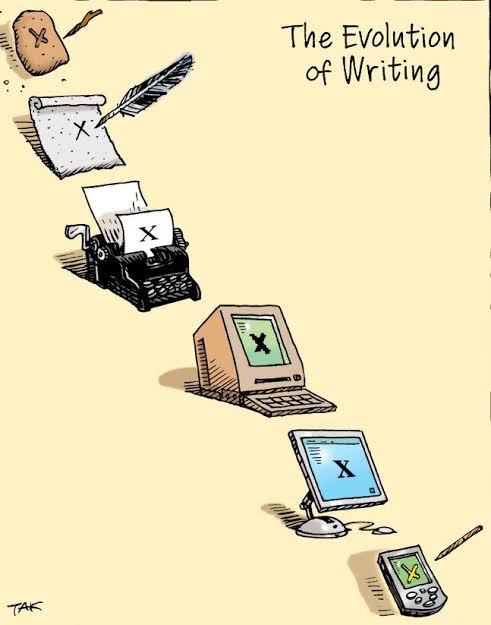

Evolution of writing ✍️

Palm leaf writing
Peacock feather writing

Dip pen writing
Fountain pen writing
Mechanical Typewriter
Ball point Pen
Electric/ Electronic Typewriter
Electronic Printer
Inkjet Printer
Laser Printer
Voice Printer
Digital Printing
3D Printing
.
.
.

Over the last few centuries, the art and the method of writing have taken many forms. Have the human thoughts also evolved and progressed during these times ?

They have evolved surely yes, due to humans conquering technology , but are they felt more beneficial to the society today? – from love, affection, devotion, valour and unity to hatred, jealous,demeaning, derogatory and destructive?

When those olden days’ scholars wrote on palm leaves, they had time to think and write scriptures or hymns or virtues that had preserved the human minds from evil thoughts and actions. Today, majority of the minds have been largely conditioned to think and act in a harmful way to fellow humans in the name of free speech and writing.

Progressive in technology, Yes.
Progressive in thoughts & actions, Not yet.

We have to blame ourselves because we have allowed us to be at this sorry state of co-existence of less love and more hatred in society that is constantly fuelled by the divisive forces and shamelessly propagated by irresponsible, guiltless media. What are we leaving behind for our future generations? Do you hope they will be less materialistic and more compassionate?

#evolutionofwriting

#hatredwriting

Capacity Planning for individuals

This is not something that we do ONLY in a factory or in an activity that consumes many hours of men and machines.

Have we anytime spent time to know our capacity and done a planning to get the best out of us? This capacity is about knowing our physical energy, mental energy and knowledge to complete a work on hand in a given time duration. By stretching our capacity, can we take up more work that is being pushed to us in the work place? No, an individual’s capacity has limitations and overloading it with more and more work breaks down people. The work on hand also suffers perfection and we don’t achieve the end goals.

Our individual capacity planning dictates us what work do we have on our plate, how much time we need more to complete that work and can we take more work. Our ability to think on these lines helps us to judge if we have reached our capacity or not. Multi-tasking is a nice trait but again if we don’t prioritise our thoughts and actions we don’t get to experience the intended outcomes.

Some individuals are bestowed with enormous amount of physical and mental energies but they also need help to prioritise what they need to do by their assistants. We wonder how a leader of an organisation or a country is able to attend to so many events / meetings and it is their assistants who help them to achieve their daily routine.

As a leader we need to assess the resources on hand to take up a job and are they enough to complete it. Demanding more work from our team without understanding the constraints doesn’t help anyone.

#capacityplanning

#mentalenergy

The Entrepreneurial trap

Entrepreneurship is a springboard for some to achieve great things as successful businessmen and is a trap for many to stay put where they had started, deeply engrossed in day to day mundane work that takes away their focus to stay and grow the business.

Most entrepreneurs don’t take help to push them out of their zone to know how are they doing and what they are doing is right or wrong. Entrepreneurial journey is not a short stint but a life long marathon that saps the energy, resources and family life. It requires great determination to stay rooted in the journey with unwavering motivation, a committed team and a supporting family.

Entrepreneurial burn-out is the most talked about syndrome in the start-up business world. One runs after money in the initial phase and later spends a lot of time in acquiring those first customers. Most of the entrepreneurs do pro-castination and fail to focus on productivity that is so essential to sustain their business.

Let us look at some of the tips from coaches that would help those running their business.

Flexibility

Businessmen are so engrossed with their day to day problems that they forget about their families and friends and think about only money. Too much focus on one issue becomes burdensome and there is no one to tell them to step out and get another perspective.

Procrastination

Some businessmen become obsessive and get bogged down about trivial administrative issues. They fail to notice other larger issues that are impacting their business that eventually derail it. They don’t know how to solve them.

Delegation

Entrepreneurs are keen to monitor everything on their own and spend a lot of time in doing it. Expanding their business and new customer acquisition get less attention. They fail to delegate routine jobs that don’t need their time and effort.

Automation

Move away from manual work of keeping accounts or calculating salaries for employees. Automation of tasks makes you organised and you find you have more time on hand to spend on business. Automation can be extended to your processes too. It may cost you more but benefits will repay the costs.

Handling debts

It is not right to deploy all your funds in the business. You have your family to take care of. Loans are essential to expand your business or for product development. Don’t shy away from taking a loan that can be managed and repaid on time. Accumulation of debts takes you towards huge cash outflows as interest payments and eventually that kills your business. Always keep the debts to a manageable level.

Books of accounts

It is a good habit to know from your accountant about the incomes / expenses, tax obligations, tax benefits and government notifications. Tracking your book of accounts once in a fortnight helps to avoid surprises at a later date.

Help from a coach / expert

It is not wrong to take guidance from coaches/ Experts to help with you inputs about the market, competition, strategies and your strong & weak areas. Sometime you forget the real value in you.

It is a great feeling to start a business but running it to earn good profits requires deep commitment, a good team, good understanding of customer expectations and a supportive family.

All the best !

#entrepreneurship

#entrepreneur

Work- Life Integration

Work -Life balance has given way to work – life integration. In the traditional way, we used set aside 8 hours for work, 8 hours for family & prayers and 8 hours for sleep & rest. This is a disciplined way of leading our life when we worked in a factory or an office. In the IT era , we worked without any boundary to our working hours, working with our laptops at the airports, cafeterias and even at home dining table.

This led to a new concept of work-life balance to enable we spend a good amount of time with the family. Work and life were made to look disconnected and there was a hard line separating them. Vacations were encouraged, family days were invented and weekend work was discouraged. In spite of these arrangements, were we able to switch off our minds totally from work? Physically we were with the family but mentally we were still at work. Didn’t we? Both employers and families didn’t seem to get the best out of this system. Boss was unhappy and wife/ kids / parents were unhappy too.

But did our ancestors follow this pattern? Somehow I feel they were more organised and seamlessly brought in work -life integration. Agreed, they were not running after money, their lives going at a leisurely pace and doing this way they accumulated wealth for their next generations.

How did they do?

They used to sit at the front porch speaking to family members and also instructing workers what they must do and where they need to go. Men travelled with family to attend to some functions and at the same time attend a court hearing or buy something for their farms. Women did the daily chores but were also planning for the years ahead and did what was needed for the elders, the children and the husband. The list goes on…

A new concept is now emerging – work -Life integration.

Work-life integration creates flow and harmony between all aspects of our life. Instead of separating work and home, responsibilities get done when they need to according to the schedule that fits us the best.

But work-life integration isn’t about finding a ‘perfect’ balance between work and life. It’s about finding a balance that works for you. It’ll look different for everyone and change over time as your circumstances change. The key is to create a balance that works for you and be flexible and adaptable.

Here are some tips:

Take your family along on a business trip

Have business meetings at far away places with spouses spending their time on their own or together.

Establish yoga center or walking clubs or Exercise spot that keep the minds and the body agile at the work place.

Have a flexible WFH or a part – time work schedule, not like the one we had during COVID that had a burn-out effect on people.

If the spouse or kid is unwell, do your work from home.

Prioritising & Delegation are important aspects of work-life integration. You just can’t do all the work yourself that keeps you occupied all the time with no time to family.

Keep your video calls or zoom meetings short in day to day work. You will find you have a lot of time on your hands that you could use for the family.

Conduct awareness programs to employees on work-life integration and how it will help them and families.

Working mothers have tough time to mange infants. Let them choose their own work hours that go with the child’s sleeping schedule.

The rewards of WLI is huge if planned well and followed by everyone at the office. You could manage attrition in a better way with more satisfied employees.

Go on and read this stuff:

https://www.betterup.com/blog/work-life-integration

There are loads of stuff and suggestions on this subject is available on the Internet. Choose the best approach that suits you if you are a leader in an organisation.

#worklifeintegration

#worklifebalance

The power of our voice

Most of us are indifferent to what is happening to others – injustice and discrimination. We get affected only when they happen to us. We don’t stand-up and voice our opinion or view when others go through a tough situation that seems to be out of prejudice, inequality, racial or communal view. As long as they don’t happen to us, we remain unperturbed and unsupportive to the affected persons.

We remain in oblivion and fail to establish the fairness in dealing with people. We don’t ask questions when discrimination happens in front of us. We don’t speak up and voice what is right and wrong.

A society becomes more aware of its duty when individuals become aware of their rights and obligations to that society that is essentially a collection of individuals.

The young minds in our midst need to be educated as to why they should stand up against unfairness. It starts at our home.

A video that has come up in my WA feed is a poignant reminder of what we are supposed to do and know how our voice could bring about changes in people and the Government.

#discrimination

#inequality

#injustice

#raiseyourvoice

Thanks to original maker of this video

ERP Transformation program – Important Pre-program initiatives

A ERP/ SAP implementation program is an assortment of many projects within and each of these projects hold the key for a successful ERP/SAP transformation program. Let us see how we handle them.

  1. Business Process Improvements

As we make progress in the capability of men and machine, we always find there is a better way of doing a process. We look upto industry peers or get to know how a software like SAP or Oracle suggests better or best practices. It is the responsibility of business process owner to decide if a new or modified process is best suited to the needs of the business. There are many process owners in an organisation and the process improvement areas are identified, business function wise. They are then mapped into the software for fitment. They may have business fits directly or some workarounds are conceived for custom code developments. This is a huge exercise without which a SAP or ERP program is never called a transformation program. This is run as a project with an owner taking the responsibility and working with the consulting team. The gains are enormous for the organisation when they are collectively implemented.

2. Change Management drive

This is the most critical aspect of a business transformation program. The introduction of an ERP across all the business functions of the organisation makes the people to think they would be made redundant and would lose their jobs. Here where the role of a Change Management Champion becomes important. This role works with the business and alleys the fears about their jobs and assures them that they need to align with the software processes that would involve not only changes to how the end users have been doing their jobs but also what process steps they would let go and what they would add to their daily routine, including the possible role changes. The resistance to introduce ERP is slowly removed through constant communication about the larger benefits of the program. A detailed schedule of training is prepared for each process owner and business owner so that they become equipped on how to work on the system and get the best out of it.

3. Data management and migration

In a running business there are many masters such as raw materials, semifinished materials, finished materials, customers, vendors, employees, finance masters, Fixed assets, payment terms are kept as master records. The end users own these masters for their respective business function. The organisation has different names and part nos for the same part as per the user department. Data management exercise removes this duplicity of master records, arranges them with a common name & one part no. Single source of truth for masters helps in reporting and decision making. Data profiling is done to identify the data types, structures as well the quality of data. The rearranged and cleansed master records are then migrated from the existing legacy system to the new ERP system. The bottom line is, only the quality and enriched data that will help the users are migrated to the new system. Data migration is a big exercise in a large organisation as it involves voluminous records that have to be mapped onto the new system with transformation rules. The data migration is done using the right tools that provide accurate results, requiring minimum manual efforts and through automation. Data migration strategy and execution is done under the close supervision of a specialist in the organisation and he works closely with the consulting team.

The above 3 projects – Business Process Improvements, Change Management and Master data Preparation are important from the perspective of pre program preparation and these projects get started even before the actual kick-off of the ERP transformation program. The three champions driving these individual projects need to be a part of the program steering committee. Most of the transformation programs fail when these projects fail.

There are other individual tracks / events like User Testing, Roles & Authorisation, Custom Code Developments, Data Migration, Open Transactions migration, Go Live event preparedness, Go – Live and Go – Live Support, during the ERP implementation project.

#erptransformation #saptransformation

#digitalttansformation

The Semicon boom that is waiting to explode.

Towards the end of 1990’s, India’s IT powerhouses and software talents came to the limelight to thwart Y2K challenges and boom, Indian IT came off age with that unintended opportunity . There was no looking back since then. Today it is $250 billion business for Indian software service sector from a mere $ 1 billion in 1996.

There is a big time re-jig happening in that sector with traditional IT services taking a back seat with AI /ML taking the center stage. This shift in focus is going to rewrite our march to become a powerhouse in digital and AI aided software services.

Taking a quick look away from the IT services, what is catching our imagination is the big push towards making India a destination for Semiconductor manufacturing. The chip business offers a great potential to leap into a high end value services in electronic industry that need talents of huge proportion similar to what we had achieved in building a huge talent capacity from academic institutions to serve IT / ITES industry as it moved from Y2K to ERP to Cloud to IoT to AI milestones in the last 25 years.

It is estimated that India would need 300,000 head counts by 2026 to fuel this growth to reach $ 350 billion in value in manufacturing of semiconductor chips & components and electronics industry services.

How are we going to address this enormous challenge?

Courtesy: Go on and read the valuable insights to prepare India to meet the challenges – in the article by Dr S Vaidy Subramaniam, Vice Chancellor of SASTRA University.

https://www.thehindubusinessline.com/opinion/scripting-semicon-success/article67918018.ece

Time-out

How often we use this gesture in our daily life, be it professional or family ? We have seen it happening in sports but that is to do with strategising the moves in an on-going game. The coach animatedly shouts down the ears of the players during these time-outs.

Do we use this technique if we get into a quarrel or argument with our partner or friend or colleague or parent?

It is an excellent way of calling a truce for sometime, think over on what caused the disagreement and later get into a chat in a calm manner. Some people gets into meditation after a time-out before resuming the discussion. It is important that a dialogue happens to appreciate the point of views and to put an end card to argument. In a team meeting too, this time-out technique could be used by the convenor of the meeting of groups when they are at each other’s throat.

After all we don’t want to hurt our partner or spouse or colleague 😊

India not in a recession

This is indeed a heartening news to note India is not going to be in a recession in 2024 and 2025. Two economies, UK and Japan, have already contracted and there is a prediction that US may also join them in this year.

A slew of developmental programs, tight leash on monetary controls by the central bank, buoyant share markets, continued spending by the public have all contributed to a steady GDP growth. A shot in the arm for the ruling NDA in the general elections will no doubt help the economy as a stable government is a major factor for a positive outlook all around.

#indiagdp

#recession

https://www.livemint.com/economy/indian-economy-a-bright-spot-while-japan-uk-fall-into-technical-recession-what-this-means-for-the-global-market-11708091380673.html

Hack your own mind

Today the world talks more and more about hacking of personal data and company data compromising sensitive information that results in loss of trillion of dollars.

In a normal parlance, as we understand, the word ‘hack’ is related to hacking a network or a computer server. In a simpler term, it is stealing or changing the data through unauthorised access to a network of computer system. It is a punishable crime.

What if we decide to do an ethical act of hacking our own mind? It is a laudable action !

Our mind, over the years, has accumulated a lot of garbage that prevents us from performing to the best of our ability to think and act better. Plenty of stored unwanted data in our mind clutters our thinking process because these data about people, places and society not only harms our growth but others too. We always surround ourselves with negative vibes like jealousy, hatred, vindictiveness, pompous, demeaning behaviour, bad habits, unnecessary fear, bad addictions, strained relationships etc and they are the road blocks to our happiness and growth.

How do we do an ethical hacking of our mind?

* One can take a spiritual way of staying clear of unpleasant thoughts. Follow a person who can help achieve this objective.

* One can decide to watch and hear only good thoughts that cultivate friendliness, happiness and fairness.

* One can read books of stalwarts who inspired us. Their life stories carry a lot of information on how they achieved a pinnacle of status that we would want to emulate.

* One can take a renewed interest in people near and dear to you because a happier family of relatives and friends makes you to keep in mind their success, well being and happiness also.

* One can start devoting some hours to reach out to those who need a lot of help, empathy and compassion. Helping them to alleviate their sufferings in a small way makes you feel wonderful.

* One can start moving with a group of people who you find are like you but happier than you. Such a company of friends or people takes the burden of bad vibes off your shoulders and feels light and wanted.

* One can start praying to the Almighty, if you believe in Him, because prayers help to channelise our minds into good actions.

Well, there could be many other ways to hack your own mind and cleanse it to turn into a happy father or mother or son or daughter or spouse or friend or co-worker. You then become an ethical hacker of mind like all those renowned gurus and leaders.

Hacking of your mind is not a one time process but a continuous self-cleaning and self-healing process.

There are plenty of books available about Mind Hacking but you choose what is best for you to read and follow.

Happy Hacking !